
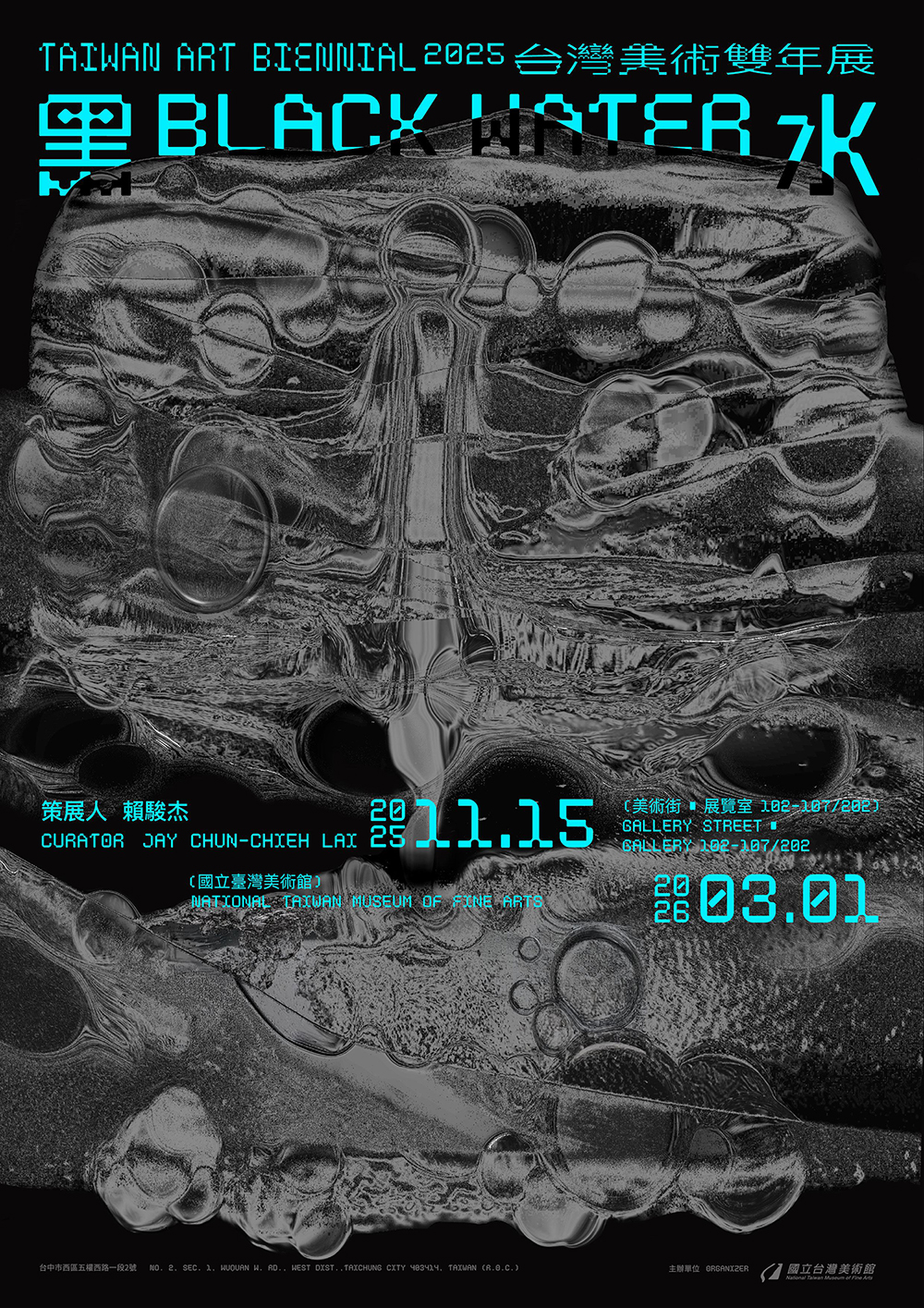
Chen Chieh-jen|Black Water: Taiwan Art Biennel|National Taiwan Museum of Fine Arts
Worn AwayDates|2025.11.15 – 2026.03.01
Hour|Tue-Fri 9:00 - 17:00, Sat-Sun 9:00 - 18:00
Venue|Exhibition Rooms 102-107, 202, Art Street(Main Building)
Curator|Jay Chun-Chieh Lai
The artist Chen Chieh-jen's work “Worn Away“is presented in the Black Water: Taiwan Art Biennial from 11th November to 1st March. This work deconstructs the illusions manufactured by the empire by creating a cinematic space that brings different performers together, who represent various types of controlled laborers and disqualified dissidents. Both performers and audiences are enabled to develop their own imaginations and interpretations of the incomplete narrative, continuously expanding the meaning of the event.
The starting point for the video's narrative is the fact that human society has entered a Techno-feudalism era that appears magnificently beautiful on its surface. In the opening scene, an AI generated female voice issues from a smartphone informs the unemployed, no longer creditworthy owner of the phone that he must immediately report to the “Transit Area” for processing because he failed to resume making payments after his grace period for the Optimization of Biological Function Assistance Program planned by the corporatocracy expired.
Upon arriving in the “Transit Area”, which is surrounded by a chain-linked fence and surveillance devices, the unemployed man sees a labyrinth of countless boxes for discarded people. Once he gets into his own box, strips of paper on which those already living in the “Transit Area” have narrated their experiences of becoming disposable subjects of human biological experiments reach his hands via a secret passageway connecting the maze of boxes. It is then revealed that in addition to the personal experiences of those unknown people, the papers also tell of how the corporatocracy fabricated various illusions to gradually force the majority of human society into hopeless circumstances.
Chen Chieh-jen(1960-)frequently receives overseas invitation, and his works were collected by several significant art museums, such as Art Sonje Center , Seoul ; Centre Georges-Pompidou, Paris; M+, Hong Kong; Mori Art Museum, Tokyo, etc. His works had been presented in many international museums, such as Vienna Secession, MUDAM Luxembourg, Tate, Taipei Fine Arts Museum, Museo Nacional Centro de Arte Reina Sofía, Galerie Nationale du Jeu de Paume, etc. Additionally, he had also been invited to engaged in the dozens of contemporary art biennials and more than a hundred exhibitions in Venice, Sao Paulo, Lyon, Liverpool, Gothenburg, Istanbul, Moscow, Sydney, Taipei, Shanghai and so on.
▌Curatorial Statement
Black Water
"Black Water," the theme of this year's Taiwan Art Biennale, carries a dark and lurking imagery, metaphorically representing the horrific experiences of migration, diaspora, and multiple colonizations in Taiwan's history. The exhibition title is inspired by the concept of "darker side" from decolonization theorist Walter D. Mignolo, using it to explore long-neglected or obscured issues in Taiwanese art history.
When considering Taiwan's history and people, the color "black" intuitively evokes images of the "Black Ditch" and its associated legends and stories. In terms of time, it extends to the colonial history of maritime empires; in terms of space, it symbolizes the global framework of modern capitalism, with the Black Ditch acting as an imagined spiritual barrier, drawing a historical divide with the world (especially with China on the other side).
Black also alludes to the long-standing discrimination and oppression of indigenous peoples and groups under colonialism by settlers, echoing the historical shadow of the "White Terror" and touching upon feelings and emotions such as fear, pain, forgetting, and subtlety. This "black water" is not simply darkness or terror, but rather a kind of obscuring and disorientation; in black, one cannot see the path ahead, while in extreme white, there is a sense of disorientation that even one cannot clearly perceive. Therefore, this exhibition is named "black" rather than "dark(er)".
Conversely, "water" plays a crucial role as a dynamic and metaphorical image, representing Taiwan from an archipelago perspective and highlighting its fluidity. It also reminds us that historical memory is not indestructible; it can be washed away, misinterpreted, and even forgotten. This body of water, inextricably linked to global concerns, is both a ferry crossing for those who arrive and a secluded path for those who depart; it is a conduit for trade and colonization, and also a field of violence and memory. These images help us envision the possibility of rewriting history: not a singular and universal history, but one that acknowledges the need for a constantly dynamic way of thinking in historical writing, confronting the various unfinished stories that are still obscured or hidden.
"Black Water" is divided into three sub-themes: "Arrival," "Settlement," and "Arrival-Becoming." These sub-themes are not absolutely defined by class or time; rather, they resemble a cyclical and transformative process of subjective identity. How does "Arrival" in history, after encountering "Settlement," transform into the yet-to-arrive "Arrival-Becoming"? How is identity shaped during migration? And how is historical writing recorded and affirmed amidst the interplay of fear and forgetting?
This year's biennial takes this as its core, and through the diverse perspectives of contemporary art, it re-examines the historical writing and cultural situation of Taiwan since the postwar period, questions the historical views and writing frameworks that were previously centered on the mainland and regime change, and attempts to understand the global positioning of contemporary Taiwan from the perspective of geopolitics and local experience.
More information
The starting point for the video's narrative is the fact that human society has entered a Techno-feudalism era that appears magnificently beautiful on its surface. In the opening scene, an AI generated female voice issues from a smartphone informs the unemployed, no longer creditworthy owner of the phone that he must immediately report to the “Transit Area” for processing because he failed to resume making payments after his grace period for the Optimization of Biological Function Assistance Program planned by the corporatocracy expired.
Upon arriving in the “Transit Area”, which is surrounded by a chain-linked fence and surveillance devices, the unemployed man sees a labyrinth of countless boxes for discarded people. Once he gets into his own box, strips of paper on which those already living in the “Transit Area” have narrated their experiences of becoming disposable subjects of human biological experiments reach his hands via a secret passageway connecting the maze of boxes. It is then revealed that in addition to the personal experiences of those unknown people, the papers also tell of how the corporatocracy fabricated various illusions to gradually force the majority of human society into hopeless circumstances.
Chen Chieh-jen(1960-)frequently receives overseas invitation, and his works were collected by several significant art museums, such as Art Sonje Center , Seoul ; Centre Georges-Pompidou, Paris; M+, Hong Kong; Mori Art Museum, Tokyo, etc. His works had been presented in many international museums, such as Vienna Secession, MUDAM Luxembourg, Tate, Taipei Fine Arts Museum, Museo Nacional Centro de Arte Reina Sofía, Galerie Nationale du Jeu de Paume, etc. Additionally, he had also been invited to engaged in the dozens of contemporary art biennials and more than a hundred exhibitions in Venice, Sao Paulo, Lyon, Liverpool, Gothenburg, Istanbul, Moscow, Sydney, Taipei, Shanghai and so on.
▌Curatorial Statement
Black Water
"Black Water," the theme of this year's Taiwan Art Biennale, carries a dark and lurking imagery, metaphorically representing the horrific experiences of migration, diaspora, and multiple colonizations in Taiwan's history. The exhibition title is inspired by the concept of "darker side" from decolonization theorist Walter D. Mignolo, using it to explore long-neglected or obscured issues in Taiwanese art history.
When considering Taiwan's history and people, the color "black" intuitively evokes images of the "Black Ditch" and its associated legends and stories. In terms of time, it extends to the colonial history of maritime empires; in terms of space, it symbolizes the global framework of modern capitalism, with the Black Ditch acting as an imagined spiritual barrier, drawing a historical divide with the world (especially with China on the other side).
Black also alludes to the long-standing discrimination and oppression of indigenous peoples and groups under colonialism by settlers, echoing the historical shadow of the "White Terror" and touching upon feelings and emotions such as fear, pain, forgetting, and subtlety. This "black water" is not simply darkness or terror, but rather a kind of obscuring and disorientation; in black, one cannot see the path ahead, while in extreme white, there is a sense of disorientation that even one cannot clearly perceive. Therefore, this exhibition is named "black" rather than "dark(er)".
Conversely, "water" plays a crucial role as a dynamic and metaphorical image, representing Taiwan from an archipelago perspective and highlighting its fluidity. It also reminds us that historical memory is not indestructible; it can be washed away, misinterpreted, and even forgotten. This body of water, inextricably linked to global concerns, is both a ferry crossing for those who arrive and a secluded path for those who depart; it is a conduit for trade and colonization, and also a field of violence and memory. These images help us envision the possibility of rewriting history: not a singular and universal history, but one that acknowledges the need for a constantly dynamic way of thinking in historical writing, confronting the various unfinished stories that are still obscured or hidden.
"Black Water" is divided into three sub-themes: "Arrival," "Settlement," and "Arrival-Becoming." These sub-themes are not absolutely defined by class or time; rather, they resemble a cyclical and transformative process of subjective identity. How does "Arrival" in history, after encountering "Settlement," transform into the yet-to-arrive "Arrival-Becoming"? How is identity shaped during migration? And how is historical writing recorded and affirmed amidst the interplay of fear and forgetting?
This year's biennial takes this as its core, and through the diverse perspectives of contemporary art, it re-examines the historical writing and cultural situation of Taiwan since the postwar period, questions the historical views and writing frameworks that were previously centered on the mainland and regime change, and attempts to understand the global positioning of contemporary Taiwan from the perspective of geopolitics and local experience.
More information